
03 Jun What Is IDMP and Why Is It Transforming Pharmaceutical Regulatory Affairs?
From Regulatory Documents to Structured Data: Understanding the Future of Medicinal Product Information Management
The pharmaceutical industry is undergoing a fundamental shift in how medicinal product information is managed, exchanged and used. For decades, regulatory processes have been largely document-driven. Product information has been captured within regulatory dossiers, application forms, PDFs and spreadsheets. While initiatives such as the Electronic Common Technical Document (eCTD) digitised submissions, much of the underlying information has remained fragmented across organisations, systems and regulatory authorities.
Today, regulators are moving towards a new model built around structured data. At the centre of this transformation is IDMP – the Identification of Medicinal Products.
IDMP represents one of the most significant regulatory data initiatives undertaken by the pharmaceutical industry. Its objective is not simply to standardise product information but to create a common framework that allows medicinal products to be identified, described and exchanged consistently across companies, regulators and healthcare systems.
For regulatory affairs professionals, understanding IDMP is becoming increasingly important. As implementation progresses across Europe and beyond, IDMP is shaping the future of regulatory submissions, pharmacovigilance, product lifecycle management and digital healthcare.
What Does IDMP Stand For?
IDMP stands for Identification of Medicinal Products.
It is a collection of international ISO standards developed to provide a consistent and globally harmonised approach to medicinal product identification.
The standards were created to address a long-standing challenge within healthcare and regulation: different organisations often describe the same medicinal product in different ways.
A product may have:
- Different brand names in different countries
- Different packaging configurations
- Different strength expressions
- Different data structures across internal systems
- Different terminology used by regulators
These variations create challenges when organisations need to exchange information, perform safety monitoring or compare products across multiple markets.
IDMP provides a common language for medicinal product information, helping ensure that pharmaceutical companies, regulators and healthcare systems are referring to products in a consistent way.
Why Was IDMP Created?
The primary goal of IDMP is to improve the quality, consistency and interoperability of medicinal product information.
Historically, much of the information relating to medicinal products has been stored within documents rather than structured databases. While this information may be available, it is often difficult to reuse, analyse or exchange efficiently.
This creates challenges when organisations need to:
- Identify products accurately
- Exchange product information between systems
- Monitor medicine safety
- Investigate adverse events
- Analyse shortages
- Compare products across markets
- Support digital healthcare initiatives
The need for better product identification became particularly important from a pharmacovigilance perspective.
When regulators receive adverse event reports, they need to determine exactly which medicinal product is involved. Inconsistent product descriptions can make this difficult, particularly when products are marketed under different names or in different presentations across countries.
By introducing standardised product identifiers and data structures, IDMP helps create a more reliable foundation for product identification and regulatory decision-making.
However, the benefits extend far beyond pharmacovigilance. Structured product information can support regulatory efficiency, improve data quality and enable future digital healthcare systems.
From Paper Dossiers to Structured Data: The Evolution of Regulatory Submissions
To understand the significance of IDMP, it is helpful to consider how regulatory submissions have evolved.
Historically, pharmaceutical companies submitted large paper dossiers to regulatory authorities. These dossiers often consisted of thousands of pages containing information about product quality, safety and efficacy.
The introduction of the eCTD transformed how submissions were exchanged. Instead of shipping physical dossiers, companies could submit electronic files organised within a standard structure.
While this represented a major advance, it did not fundamentally change how information was managed.
Much of the critical information remained locked within documents rather than existing as structured data.
As a result, organisations frequently found themselves maintaining the same information in multiple places:
- Regulatory information management systems
- Product databases
- Manufacturing systems
- Pharmacovigilance systems
- Supply chain systems
- Submission documents
This duplication creates inefficiencies and increases the risk of inconsistencies.
IDMP represents the next stage of regulatory digitalisation. Rather than simply exchanging documents electronically, regulators are increasingly moving towards structured data exchange where information can be reused across multiple regulatory processes.
The long-term vision is a regulatory environment where product information is entered once, maintained consistently and used across numerous regulatory activities without repeated manual transcription.
Understanding the Five IDMP Standards
IDMP is not a single standard. Instead, it consists of five interconnected ISO standards that work together to describe medicinal products comprehensively.
Medicinal Products
This standard describes medicinal products as they are authorised within a specific market.
It includes information such as:
- Product names
- Marketing authorisation information
- Package details
- Country-specific information
Pharmaceutical Products
The pharmaceutical product represents the product as administered to the patient. This distinction is important because some products require preparation before administration. For example, a product may be supplied as a powder and solvent but administered as a solution for injection.
Substance Information
This standard describes the substances contained within medicinal products, including active substances and excipients.
Controlled Vocabularies
Standard terminology is essential for consistency. This standard defines controlled vocabularies for:
- Pharmaceutical dose forms
- Routes of administration
- Units of presentation
- Packaging descriptions
Units of Measurement
This standard ensures consistency when expressing measurements such as:
- Milligrams
- Millilitres
- Concentrations
- Strengths
Together, these standards create a common framework for describing medicinal products in a structured and internationally consistent way.
Understanding the IDMP “Wedding Cake”
One of the most widely recognised concepts within IDMP is the so-called “wedding cake” model. This model illustrates how medicinal product information is organised into different layers. At the foundation are the standards covering substances, controlled vocabularies and units of measurement. Building on these foundations is the pharmaceutical product layer, which describes the product that is administered to the patient. At the top sits the medicinal product itself, representing how the product is authorised and marketed within a specific jurisdiction.
The significance of this layered approach is that it allows regulators and companies to distinguish between:
- The scientific composition of a product
- The pharmaceutical form administered to patients
- The commercial and regulatory presentation of the product
This distinction becomes increasingly important when comparing products across markets or analysing product information across different regulatory systems.
Understanding the IDMP Data Model
At the heart of IDMP sits a detailed data model that defines how medicinal product information is structured. While many professionals initially view IDMP as a reporting requirement, it is more accurately described as a framework for representing medicinal product information. The data model includes several interconnected components.
Medicinal Product
The medicinal product represents the authorised product in a specific market.
This includes:
- Product name
- Marketing authorisation details
- Packaging information
- Country-specific information
Pharmaceutical Product
The pharmaceutical product represents what is administered to the patient. For some products, the medicinal product and pharmaceutical product are identical. For others, preparation is required before administration.
Packaged Product
The packaged product describes how the product is physically supplied.
This includes:
- Package sizes
- Containers
- Packaging hierarchies
- Packaging materials
Manufactured Item
Manufactured items represent the product as it leaves manufacturing.
Examples include:
- Tablets
- Capsules
- Powders
- Solutions
- Syringes
Ingredients
The model also captures detailed information relating to:
- Active substances
- Excipients
- Ingredient strengths
- Concentrations
Organisations
Manufacturers, marketing authorisation holders and other relevant organisations are linked using standardised identifiers. Together, these elements provide a highly structured representation of a medicinal product and its relationships.
The Long Road to IDMP Implementation
Although IDMP is often discussed as a current initiative, its origins stretch back more than a decade. The pharmaceutical industry and regulators recognised that medicinal product information was being managed inconsistently across systems and organisations. At the same time, regulators were seeking to improve pharmacovigilance activities and create more efficient mechanisms for exchanging product information.
This led to the development of the ISO IDMP standards. However, developing standards is only one part of the challenge. Implementing them across regulators, companies and healthcare systems has proven significantly more complex. The journey towards full implementation has required new databases, new data models, new governance approaches and substantial industry investment. Today, Europe remains the leading region in terms of practical implementation, but the process continues to evolve.
From XEVMPD to PMS: Why Europe Needed a New Product Database
A key milestone in Europe’s journey towards IDMP was the introduction of the Extended EudraVigilance Medicinal Product Dictionary (XEVMPD). Established under Article 57 pharmacovigilance requirements, XEVMPD created a central repository of medicinal product information across the European Economic Area. For the first time, pharmaceutical companies were required to submit structured medicinal product information to a central European database. This represented a major advancement in regulatory data management.
However, XEVMPD was developed before full IDMP implementation and therefore had limitations. Companies often interpreted requirements differently and submitted information with varying levels of granularity and consistency. As a result, data quality challenges emerged. The Product Management Service (PMS) has been developed to address these limitations. Unlike XEVMPD, PMS has been designed around IDMP principles and is intended to become the central source of medicinal product information within the European regulatory network.
Over time, PMS is expected to support an increasing number of regulatory processes and contribute to a more integrated regulatory environment.
SPOR: The Foundation of EMA’s IDMP Implementation
The European Medicines Agency’s implementation of IDMP is built around the SPOR programme.
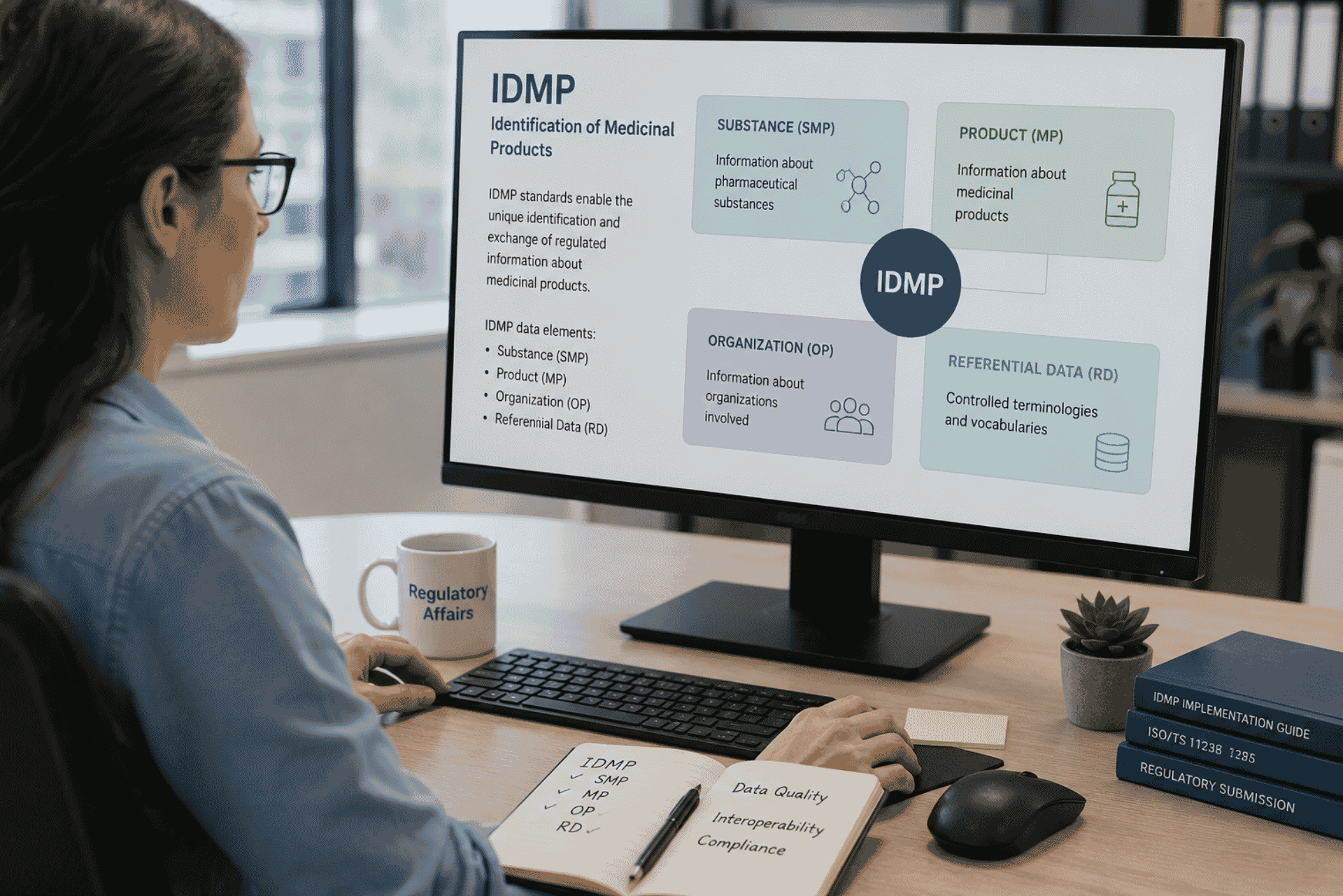
SPOR consists of four master data services.
Substance Management Services (SMS)
SMS manages substance information and provides standardised substance identifiers.
Product Management Services (PMS)
PMS provides the central product database supporting IDMP implementation.
Organisation Management Services (OMS)
OMS provides standardised information about organisations, including:
- Marketing authorisation holders
- Manufacturers
- Regulatory authorities
- Contract organisations
Referential Management Services (RMS)
RMS manages controlled vocabularies used throughout the IDMP framework.
Examples include:
- Pharmaceutical dose forms
- Routes of administration
- Manufacturing operations
- Countries
- Languages
Together, these services provide the infrastructure required to support structured medicinal product data across Europe.
Global Adoption of IDMP
Although EMA is leading implementation efforts, IDMP was never intended to be a European-only initiative. The standards were developed as international ISO standards and can be adopted globally. Regulators around the world have explored how IDMP principles can support future digital regulatory processes.
In addition to Europe, organisations such as the US FDA, Health Canada, Swissmedic and PMDA have all shown interest in structured medicinal product data and product identification frameworks.
One of the long-term ambitions is to enable greater interoperability between regulatory authorities, making it easier to exchange information and support international collaboration.
While global implementation remains at different stages of maturity, the direction of travel is clear: medicinal product information is becoming increasingly structured and data-driven.
The Real Challenge: Data Governance
One of the biggest misconceptions surrounding IDMP is that it is solely a regulatory affairs initiative. In reality, much of the information required for IDMP originates outside regulatory affairs.
For example:
| Data Area | Typical Owner |
| Substance information | Research & Development |
| Clinical indications | Clinical Development |
| Manufacturing sites | Manufacturing |
| Packaging information | Supply Chain |
| Quality information | Quality Assurance |
| Marketing authorisations | Regulatory Affairs |
This creates significant governance challenges.
Companies must establish clear answers to questions such as:
- Who owns each data element?
- Which system is the source of truth?
- How are changes communicated?
- How is data quality monitored?
- Who approves updates?
Successful IDMP implementation depends on effective collaboration between regulatory affairs, quality, manufacturing, supply chain and other functions. Without strong governance, even the best technology solutions will struggle to deliver reliable product data.
Why IDMP Is About More Than Compliance
Many organisations initially approached IDMP as a compliance project. However, the greatest value of IDMP may lie beyond regulatory compliance. By encouraging organisations to improve data quality, establish clear ownership and integrate systems more effectively, IDMP can support broader business objectives.
Potential benefits include:
- Improved operational efficiency
- Reduced manual data entry
- Better data quality
- Faster responses to regulatory requests
- Improved reporting capabilities
- Stronger support for digital transformation initiatives
Companies that view IDMP as a strategic data initiative rather than a regulatory obligation are often better positioned to realise these wider benefits.
IDMP and the Future of Regulatory Affairs
The future of regulatory affairs is increasingly data-driven. EMA is already integrating structured product data into activities such as:
- Product lifecycle management
- Shortage reporting
- Regulatory submissions
- Product databases
Future initiatives are expected to include:
- Electronic Product Information (ePI)
- Structured quality data
- Enhanced pharmacovigilance analytics
- Greater interoperability between systems
- Increased use of automation and artificial intelligence
As these initiatives develop, the importance of high-quality product data will continue to grow. Artificial intelligence, advanced analytics and future digital regulatory platforms will all depend upon structured and reliable product information. For this reason, IDMP should be viewed not simply as a compliance requirement but as a foundational component of the pharmaceutical industry’s digital future.
Conclusion
IDMP is transforming how medicinal product information is managed across the pharmaceutical industry. By creating internationally recognised standards for medicinal product identification, it provides a framework for improving data quality, supporting regulatory efficiency and enabling future digital healthcare initiatives.
While implementation remains an ongoing journey, particularly in Europe through the EMA’s SPOR programme, the direction is clear. The pharmaceutical industry is moving from document-centric regulatory processes towards structured, data-driven regulatory operations.
For regulatory affairs professionals, understanding IDMP is becoming an essential part of preparing for the future of pharmaceutical regulation.
🚀 Ready to Advance Your Skills in Drug Development?
Explore our IDMP training course: Mastering IDMP: Implementing the Identification of Medicinal Products Standard
Written by Educo Life Sciences Experts, Remco Munnik and Jeanneke Spruit
Remco Munnik has recently taken on the role of independent consultant as the founder and owner of Arcana Life Science Consulting, bringing over 20 years of deep expertise in Life Sciences and Regulatory Affairs. With more than a decade of consultancy experience, he has led initiatives in Regulatory Information Management (RIM) and electronic submissions, earning recognition as a trusted expert in the field. His subject matter expertise encompasses dossier and data management, including eCTD, xEVMPD, and ISO IDMP, positioning him as a strategic partner for regulatory transformation and compliance.
Remco’s influence extends into numerous organizations where he actively participates and holds leadership roles. These include Medicines for Europe, where he serves as the Chair of the Regulatory Data & Digital Systems (ReDDS) group; he is President of the IRISS Forum: a global, open, multidisciplinary, non-profit networking organisation for life science professionals by life science professionals; and Remco is a member of the Regulatory Optimization Group (ROG) where EMA, HMA and industry come together.
Remco strongly believes that innovation in the Life Sciences sector does not solely rely on waiting for the next significant breakthrough or a fortunate turn of events. His vision is built on the conviction that innovation is best fostered by cultivating a proactive attitude. This involves taking strategic, incremental steps that evolve into data-driven leaps, propelling us towards unprecedented discoveries and superior innovation. This proactive, calculated approach not only expedites our progress but also paves the way for ground-breaking advancements.
Jeanneke Spruit has been working on the topic of regulatory information management with different clients over the past 6 years. Her ambition is to help the pharmaceutical industry make the transition to a more efficient and transparent way of working by improving the data management practices. In her work as consultant, she supports different pharmaceutical companies around the collection, maintenance, and reuse of regulatory data. After building her experience at consulting firm Iperion and later Deloitte, she now works as independent contractor across the industry. In her daily work, she is often found chasing the source of medicinal product information within a company, ensuring that data ownership is in the right place.
Specialising in the global implementation of ISO IDMP standards, Jeanneke Spruit is passionate about fostering the internationally standardised exchange of medicinal product information. This vision aligns with a broader goal: building a more transparent and interconnected industry where patients benefit from improved access to medicinal products as well as the latest product information. With global IDMP, sharing information about medicines, their availability, and important safety information becomes straightforward and quick.
Sign up for the Educo Newsletter
Stay up-to-date with the latest free trainer interviews, articles, training courses and more. We will also keep you updated on upcoming courses. Complete the form below.
View Our Range of Training Courses
Discover our range of online and classroom courses covering various topics within Pharmaceuticals (Regulatory Affairs), Biopharmaceuticals, Cell & Gene Therapies and Medical Devices & IVDs.